
I Was Wrong About Strategy's Preferreds
Capped upside, unlimited downside

In the last year article on Strategy I wrote:
I never expected to say it, but preferreds seem to be risk-off assets now, and especially those with higher seniority can be a good alternative to bonds and other yield products.
While the article describes the mechanics correctly, the “risk-off” judgement aged like milk. Today, I classify preferreds as speculative assets with capped upside and unlimited downside—exactly the type of risk most people should never take.
If you bought them, it’s likely not over yet. We may go through another hype cycle with a better opportunity to get out. For speculators, buying during dips like the recent one is surely tempting because the price could bounce back up together with Bitcoin. That said, the uncapped risk is real, and if you haven’t taken it yet—don’t.

Saylor hypnotized Bitcoiners. I have to own that I wasn’t fully immune to his rhetorical skills. As a character in the Bitcoin universe, he went through quite an arc. No doubt, the idea to buy Bitcoin in 2019 was a brilliant move that put MicroStrategy—at the time a failing business—back on the map. Unfortunately, it looks like he gained the community’s love so abundantly that he can now abuse it without being kicked out of the house.
Where the real problems began was the “infinite money glitch” idea, which in principle is simply antithetical to Bitcoin. Even though he uses regulated instruments, the basic idea is to print “tickers” to buy Bitcoin—which is what every big ICO in 2017 did. It’s a bit of a mystery to me why so many OGs aren’t seeing it that way. I can imagine they got tired of being “maxi” for all those years, and buying a stock was kosher enough that it could pass muster within a rigorous Maximalist playbook.
The Ticker is Not a Business
In theory, when you hold MSTR 0.00%↑, you own a piece of the company so the book value of assets under management matters, but at best it’s only a “deal” when mNAV is below 1.0—any other time you pay a premium. Unfortunately, just holding stuff does not make money—a company has operating costs. You need cashflow. Otherwise you can just buy the asset directly. Strategy has it on paper, but it’s so small that it’s completely negligible at their current scale.
When you buy SpaceX, you buy a vision of the future business. It may be too optimistic, or “priced in,” but there is a vision. Strategy doesn’t even have a valid vision for generating future profits.
The Stretch
Strategy calls their preferreds "products" with Saylor comparing STRC 0.00%↑ to iPhone. Maybe the best thing to say is that, well, it's a stretch. For many investors, "fixed income" means corporate bonds, but there is a huge difference: the issuer never repays the bondholder the principal—you can only hope someone else on the market will buy it from you. First, let's check how preferreds are doing since I first wrote about them in December:
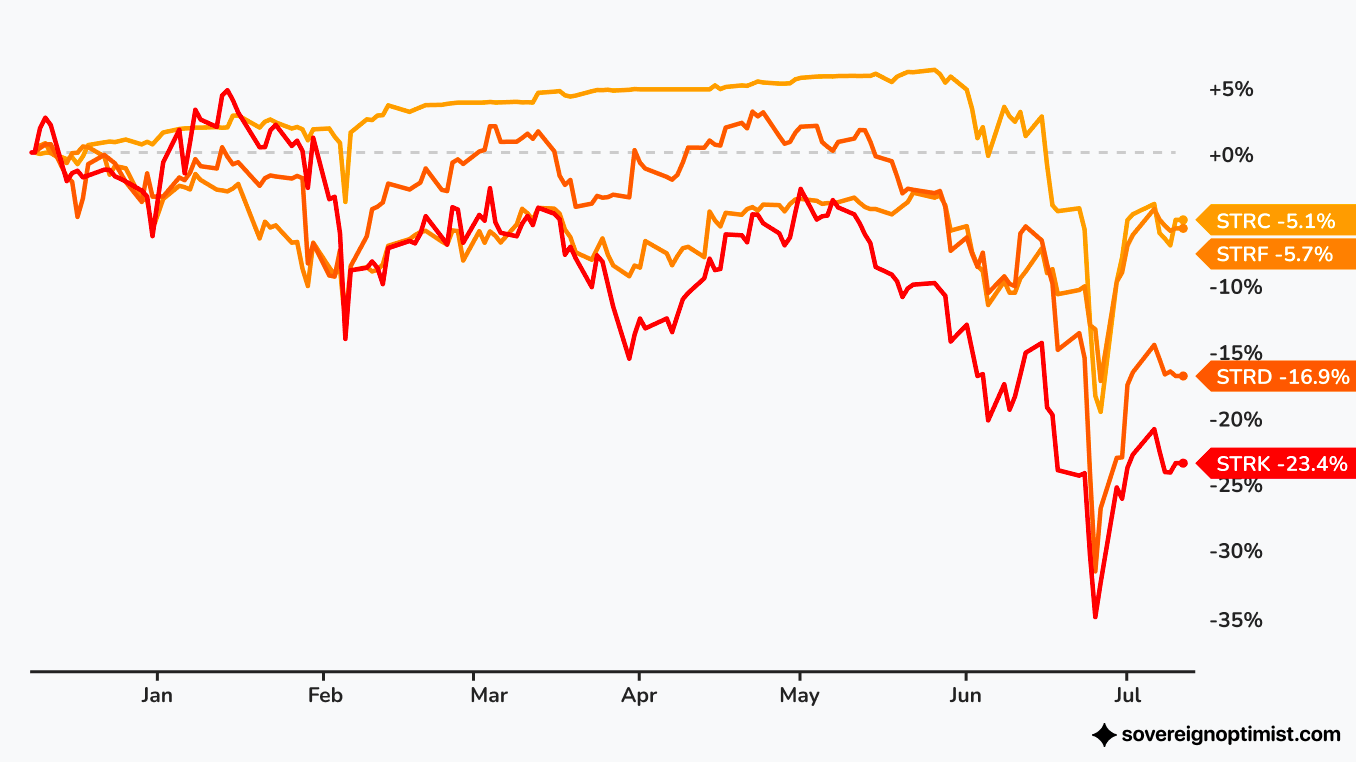
If you bought STRC 0.00%↑ and didn't panic a few days ago, it may look fine now, but notice the pattern: the older the ticker, the bigger the price drop—as if the more time passes, the lower investors' confidence becomes. That doesn't look good.
The fixed coupon sounds great only until you realize that the base price can cancel it out. You need 10 years, to get back what you invested in yield alone. So, you need to believe that Strategy will do great all that time, and holding STRC 10 years is safe. It looks like the market doesn’t believe that. For STRK 0.00%↑ it already says:
8% is not enough. You need to pay me 13.3% for me to take this risk.
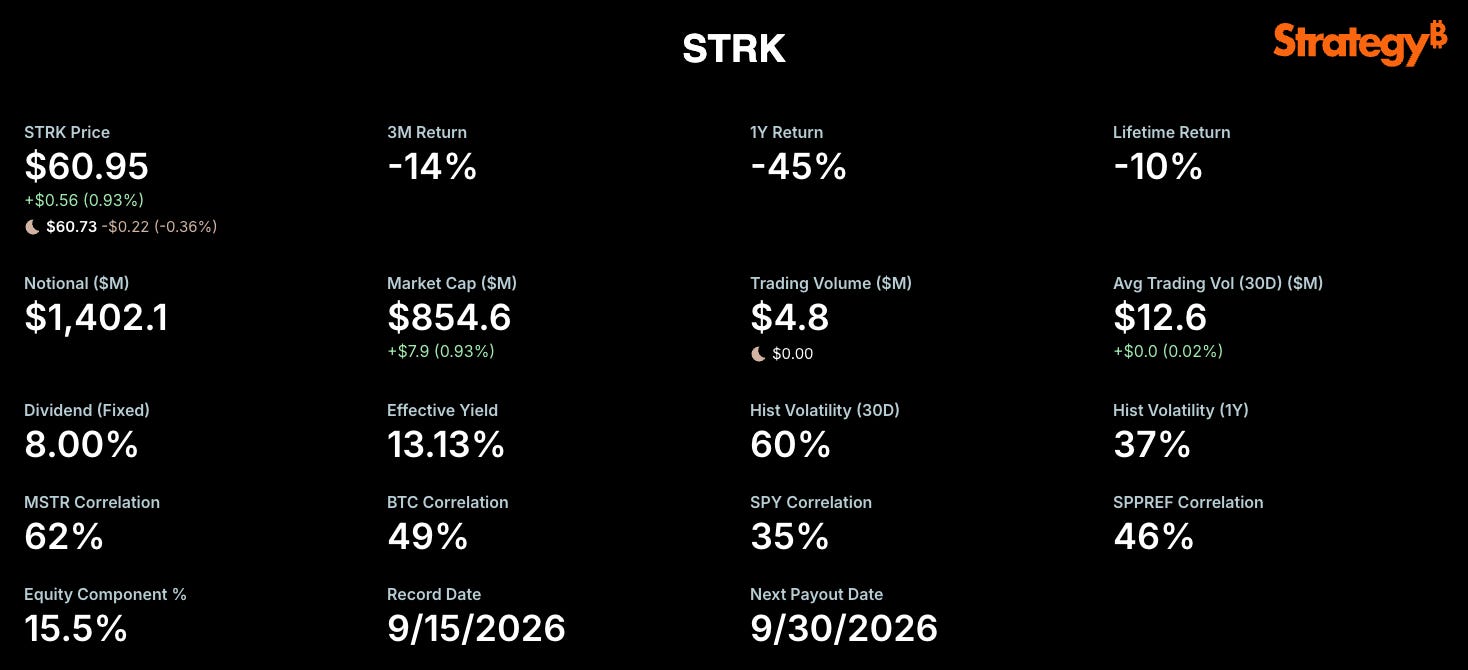
Yes, the base price relies only on market’s confidence, and as we see this confidence has limits. There is literally nothing that prevents preferreds from going to zero. It doesn’t matter if the ticket is 10% if the underlying stock goes -20%, and can repeat it year after year.
Do What They Do Not What They Say
If you listen to Saylor in recent months, he changed his language and instead of Bitcoin now talks about “digital credit.” The irony is that when he mentions Bitcoin directly, the arguments are solid, but those are the arguments to buy the underlying asset, not MSTR or their “digital credit” products. It’s a great time to add some “orange” to your portfolio, or buy BTC or IBIT 0.00%↑—stay away from exotic instruments which are all Strategy's products.
In other news:
I brought Deltabadger Reports back with a brand new interactive guide to pick a perfect S&P 500 tracker.
Our Discord community is growing. Every Monday, I post an update of the Nasdaq 20 bots’ performance, but I also started backtesting various settings and so far the 20 with equal allocation beats the 7, 12, and market cap weighting variants.
You can see a simple backtest of the Nasdaq 20 (equal) strategy on the brand new FIRE Calculator.