
Good Findings, Wrong Reading: Anthropic's Labor Report
Looking for evidence of the job apocalypse

Two weeks ago, Anthropic published a report on AI’s impact on the labor market. The headline finding: no systematic increase in unemployment for workers in AI-exposed occupations since ChatGPT launched. Nothing to see here. Yet.
Anthropic calls the new metric “observed exposure.” They took around 800 occupations from the O*NET database, mapped the tasks each job involves, then checked which of those tasks actually show up in Claude’s real-world usage data.
That’s pretty cool.
The result is a radar chart showing two layers: a blue area representing theoretical AI capability, and a red area representing actual deployment. In Computer & Math occupations, 94% of tasks are theoretically feasible for an LLM. Only 33% are currently covered. On the other end, 30% of all workers have zero AI coverage—cooks, motorcycle mechanics, lifeguards, bartenders, dishwashers.
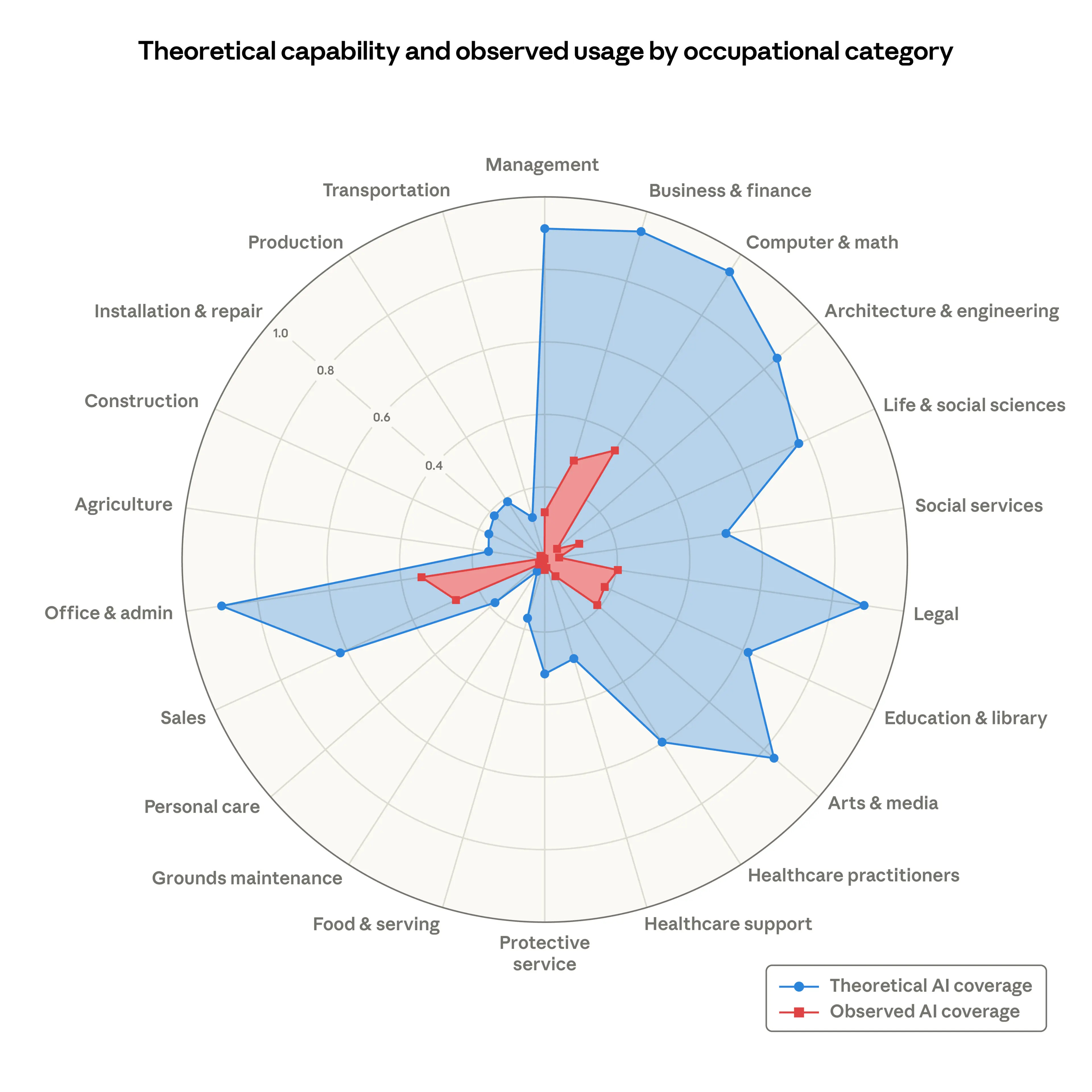
They split workers into high-exposure and low-exposure groups, and compared unemployment trends. If AI is displacing people, the exposed group should be doing worse. Their finding? Both groups move roughly in parallel. No significant divergence since late 2022.
The report has two problems:
It assumes AI is the only force that can differentiate affected and unaffected sectors—while in reality, the split mostly tracks blue-collar versus white-collar work.
It underplays the junior job market, which already shows a 14% gap.
1. It’s Camouflage
This method is sound in theory. In practice, it relies on a big assumption: that both groups—the programmers and the bartenders, the financial analysts and the lifeguards—are subject to the same economic forces besides AI.
But why assume that AI is the only differentiator?
Right now, blue-collar jobs are collapsing. Manufacturing employment is down over 100k. Trucking is declining. Tariffs are crushing trade-dependent industries across the board. These forces hit the “unexposed” comparison group hard—and have nothing to do with AI.
Meanwhile, tech companies are cutting headcount while posting record revenues. Atlassian just fired 1,600 people, while reporting 26% cloud revenue growth. Block cut 4,000 jobs to become “intelligence-native.” WiseTech eliminated 2,000 positions because, their CEO said, the era of manually writing code is over. Tech layoffs in 2026 passed 45,000 by early March.
If blue-collar jobs are falling because of tariffs, and white-collar jobs falling because of AI, the diff-in-diff registers zero.
2. Junior Jobs Market
But there’s a second problem with the report, and it might be more important than the first: it doesn’t properly examine what’s happening to entry-level workers.
To be fair, the report does look at young workers—and what it finds should have been the actual headline. Among 22-25 year olds, hiring into AI-exposed occupations dropped roughly 14% after ChatGPT launched. Hiring into unexposed occupations stayed flat. This effect doesn’t exist for workers over 25. The report mentions it, but hedges it as “just barely statistically significant.” Really?
If a company makes ten senior developers do the work of ten seniors plus five juniors it doesn’t lay anyone off, but it also doesn’t post those junior roles. There is no signal in the CPS data. The report itself explains why this disappears from statistics: young people entering the labor market for the first time don’t have a previous occupation listed in survey data. If they can’t find work and leave the labor force—go back to school, do gig work, move home—they never appear as “unemployed.”
Waiting For the Job Apocalypse
I don’t claim I know for sure. But this is the reading consistent with my experience.
AI comes for junior jobs first.
As it becomes more capable, and companies learn how to implement it properly in their workflows, it will go after positions requiring more experience. You’ll not feel the impact if you’re currently hired senior. Not yet. You may feel it if you’re looking for a job, and you’ll definitely feel it if you look for a job as a junior.
If you’re in a senior position in one of affected areas: switch from earning to owning. Invest whatever you can while you can.
If you’re starting on the market, learn entrepreneurial skills and those involving “moving atoms”—if to do the job you have to be on site, be with the customer in the same room or his living area—that is a resilient profession. You still have to invest as soon as the paycheck hits your account.
It’s time to build our “Window portfolios.”

✦
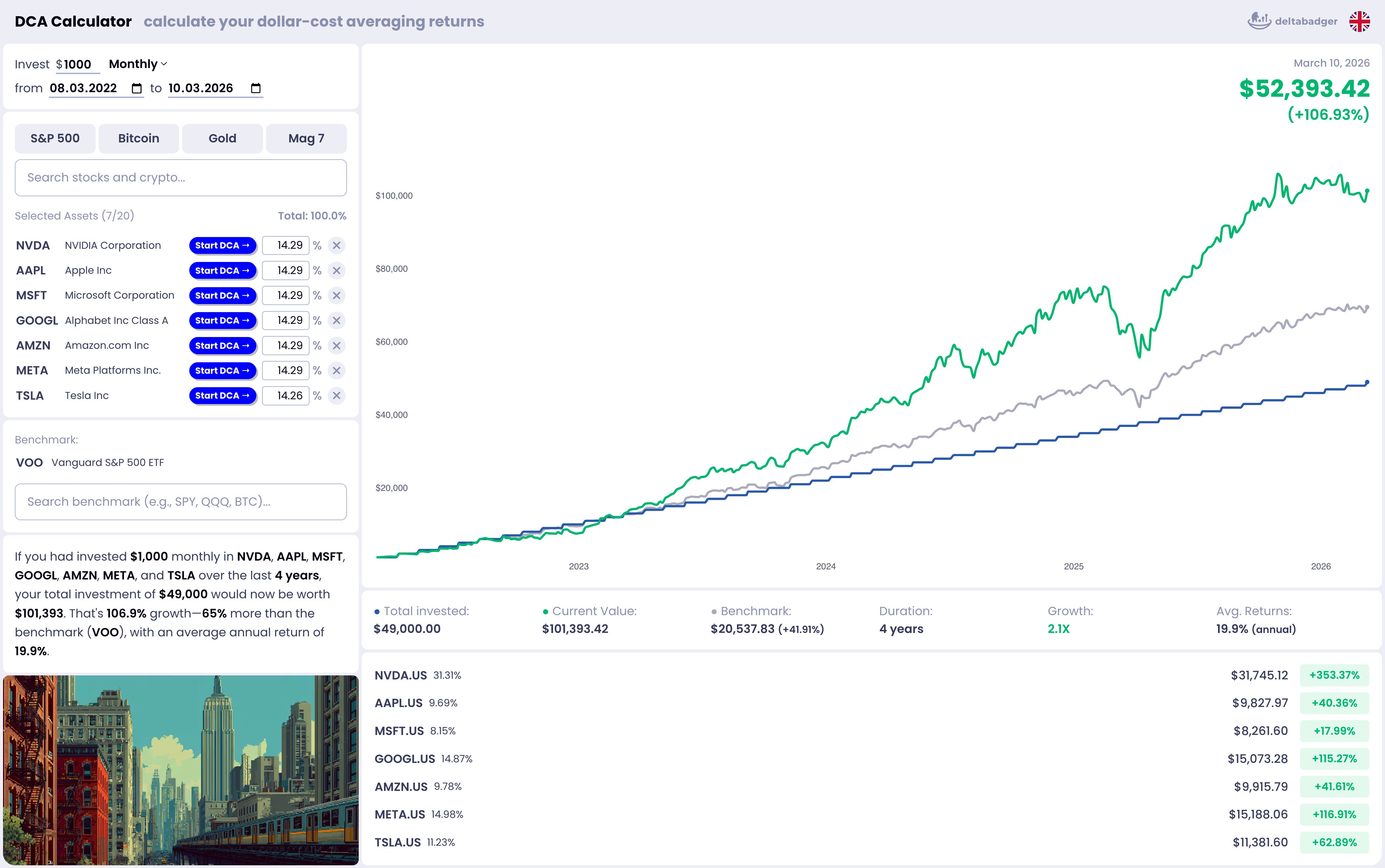
While waiting for the end of jobs, I created this dollar-cost averaging calculator that now works in almost 50 languages. It may help.
: