
Ford Didn't Predict Bitcoin 104 years ago: The Real Lesson From the 1921 Viral Article
A viral 1921 newspaper article keeps circulating with claims that Henry Ford "predicted Bitcoin." The reality is way more interesting, and tells us something important about the Bitcoin future.

If you’ve spent any time in crypto circles lately, you know how much bitcoiners love to share this screenshot:
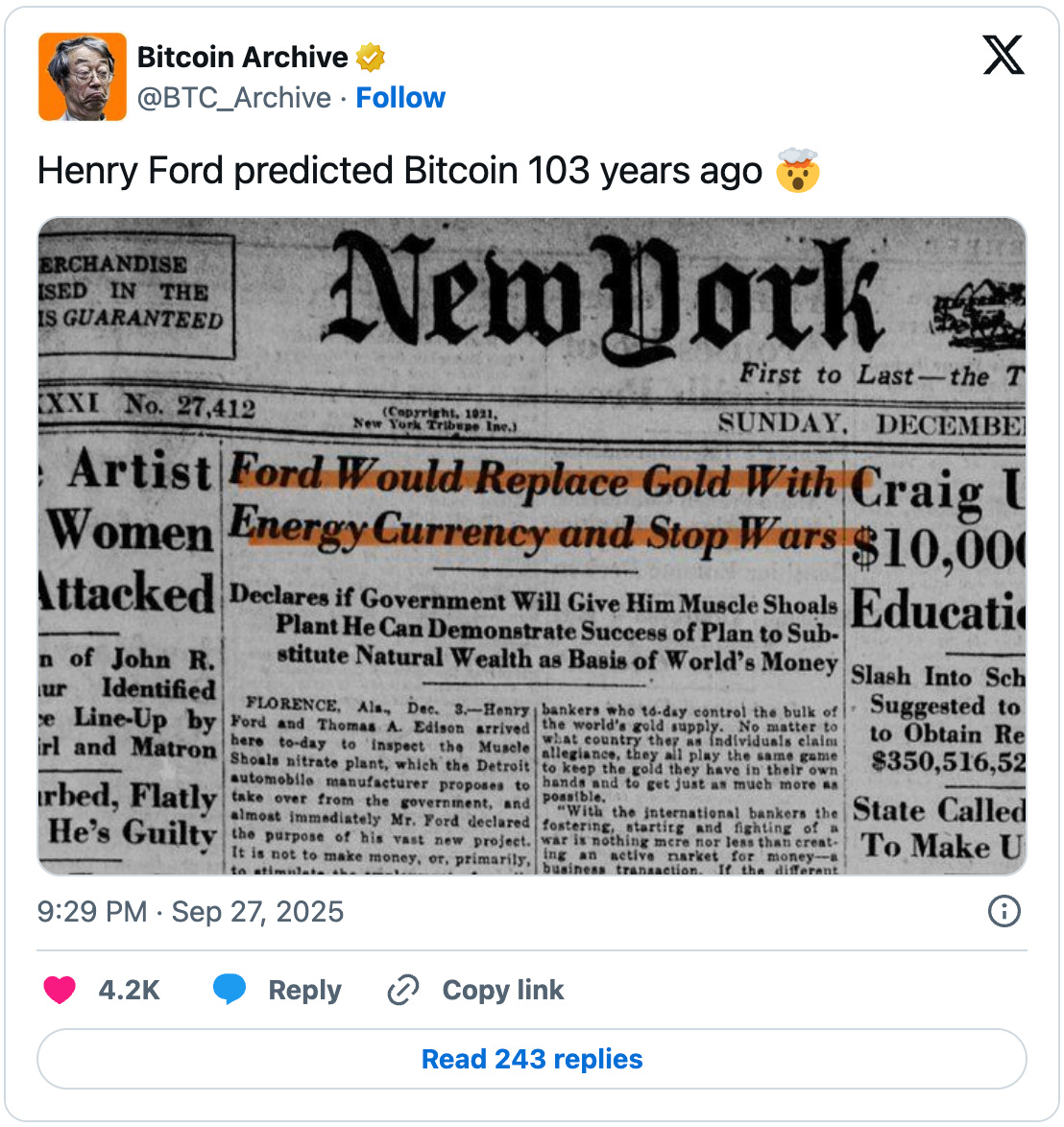
Verdict: “Henry Ford was a visionary who predicted Bitcoin 104 years ago!”
There’s just one problem:
Ford’s proposal was the exact opposite of Bitcoin.
What Ford Actually Proposed
Let’s look at what the 1921 New York Times article actually says.
To say that Ford was critical about the financial system is an understatement:
“Under the present system we go to Europe and become lenders to foreign governments. If we lend a billion, they in turn lend it back to us. Then in the end we cancel the debt. There is something decidedly foolish about this so-called international finance.”
So far, so good. However, he also didn’t like gold:
“The essential evil of gold in its relation to war is the fact that it can be controlled. Break the control and you stop war. And the simple way to break the control of the international bankers, the way to end their exploitation of humanity forever, is to end gold as the currency of the world.”
The Dam
Ford’s energy currency proposal emerged from his bid to lease the Muscle Shoals dam in Alabama. Rather than having the government borrow money through bonds to complete the dam, Ford suggested issuing currency backed by the dam’s energy output—eliminating interest payments to Wall Street entirely.
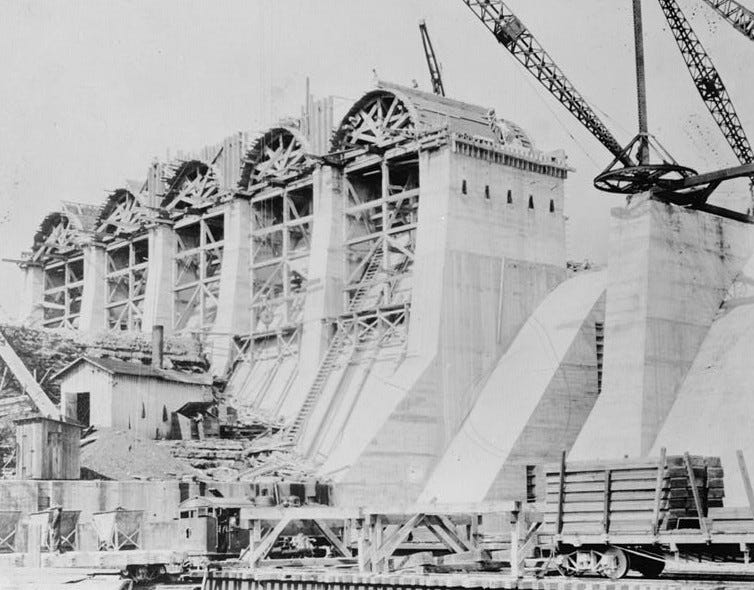
His proposed solution was to replace gold with units of energy. Ford argued that energy is ‘imperishable’ and represents real productive capacity—the ongoing power output of dams and plants that would exist for generations. Unlike gold, which sits in vaults, energy currency would be tied to actual work being done. This is the part that speaks to bitcoiners—isn’t that proof-of-work?—but then comes the hit:
Ford explicitly wanted to eliminate the ability to hoard wealth.
“Wall Street get nothing!”
Ford’s currency was designed to be anti-hoarding. Energy can’t be stored long-term in the way gold can. It dissipates, it must be continuously produced, so the currency would represent the ongoing productive capacity, not stored energy you could hoard. Ford wanted to eliminate speculation and the power of “international bankers” by making currency tied to something that couldn’t be stockpiled the way gold could.
Would he think about Bitcoin investors differently than about Wall Street investors?
“These men deserve nothing and under this plan will get nothing.”
Bitcoin: Digital Gold, Not Digital Energy
As you can see, the comparison isn’t just wrong—it’s backwards.
Bitcoin is designed to be hoarded, and the store-of-value function took over the other two: unit of account, and medium of exchange. With its fixed supply, deflationary design, “HODL” culture, Bitcoin behaves like gold that Ford hated.
Yes, Bitcoin mining consumes energy. But once mined, it can be stored indefinitely at essentially zero cost, hoarded, and used for speculation. This is precisely what Ford was trying to eliminate.
Ford wanted to remove the store-of-value function from currency to stop speculation and banker control. Bitcoin maximizes the store-of-value function as its core feature.
The Irony of Bitcoin Success
While TradFi (traditional finance) embraces Bitcoin, we’re learning that it can be “wrapped” in obfuscated financial instruments exactly like any other asset. Bitcoin ETFs, derivatives, paper Bitcoin, rehypothecation—the traditional financial system is doing to Bitcoin exactly what it did to gold.
It’s very unlikely that Ford would become a Bitcoiner:
“It is very simple when you analyze it, the cause of all wars is gold.”
For many, Bitcoin was supposed to disrupt the financial system. The irony is that instead, it’s being absorbed into it, becoming just another asset that can be financialized, leveraged, and controlled by the very institutions it was meant to replace.
Ford’s Energy Currency Idea Was Flawed
I don’t want to claim that Ford’s idea was better—a currency that cannot be stored doesn’t make any sense to me either. The three functions of money (medium of exchange, unit of account, and store of value) exist for good reasons. A currency that loses the store-of-value function is barely usable as money.
It’s important to remember that he brought this idea while he was negotiating the 99-year old lease for the dam. The idea is creative but reminds me of some of Elon Musk’s raw takes on Bitcoin and monetary system.
Three days after the original article, a New York Times editorial pointed out a fundamental contradiction: Ford proposed that “a certain amount of energy exerted for one hour would be equal to one dollar.” But if the energy unit is defined in terms of dollars, it hasn’t replaced the dollar—it’s just pegged to it.
Good point, and it leads to something interesting.
The History Rhymes
From a monetary perspective, Bitcoin shares too many properties with gold to behave differently long-term. If gold didn’t end “fiat money,” neither will Bitcoin. The idea of “hyperbitcoinization” is naive. What we saw with gold, is rather the opposite: the gold came first, but it was slowly replaced by fiat.
Gold was supposed to constrain governments and prevent monetary manipulation. It didn’t. It got abandoned when it became inconvenient (1971), and it became just another tradable asset within the fiat system. It’s also accumulated heavily by central banks that know fiat money eventually collapses.
Learn From The Goldbugs
This season we see the private sector taking full advantage of Bitcoin’s gold-like properties. Michael Saylor, one of Bitcoin’s biggest proponents, has enthusiastically embraced the ‘fiat playbook’—borrowing billions in convertible bonds at low interest rates to buy more Bitcoin, creating exactly the kind of leveraged financial speculation Ford wanted to eliminate.
Treasury companies aren’t helping to hyperbitcoinize the economy. They demonstrate how Bitcoin gets financialized, wrapped in derivatives, ETFs, and debt instruments until it becomes just another asset in the TradFi toolkit.
So, bitcoiners, learn from the goldbugs. They’ve been on this front much longer. In a way, bitcoiners are the new goldbugs to carry the torch of fiscal conservatism, and financial sovereignty. You’ll always be the niche that people mock—until the next market crash, when everyone suddenly needs to get some sats like it was toilet paper in 2020.