
Concentration Is the New Game
The crowd is still here. The wisdom is gone.

For a long time, broad market diversification was the default recommendation for retail investors, and simply buying the S&P 500 ETF is what many people these days are doing. With an average growth of 10% a year for the last two decades—it simply works.
Then Millennials and other less patient market participants started to notice that another index, Nasdaq-100, grows even faster and many started to switch from VOO 0.00%↑ to QQQ 0.00%↑ . 100 companies seem diversified enough, and it’s hard to not notice that this is where the majority of the growth happens.
The uncomfortable truth is that the majority of the growth happens even closer to the top. Much closer. If you ever heard about the Magnificent 7 you know exactly what I mean. Yes, it’s this chart:
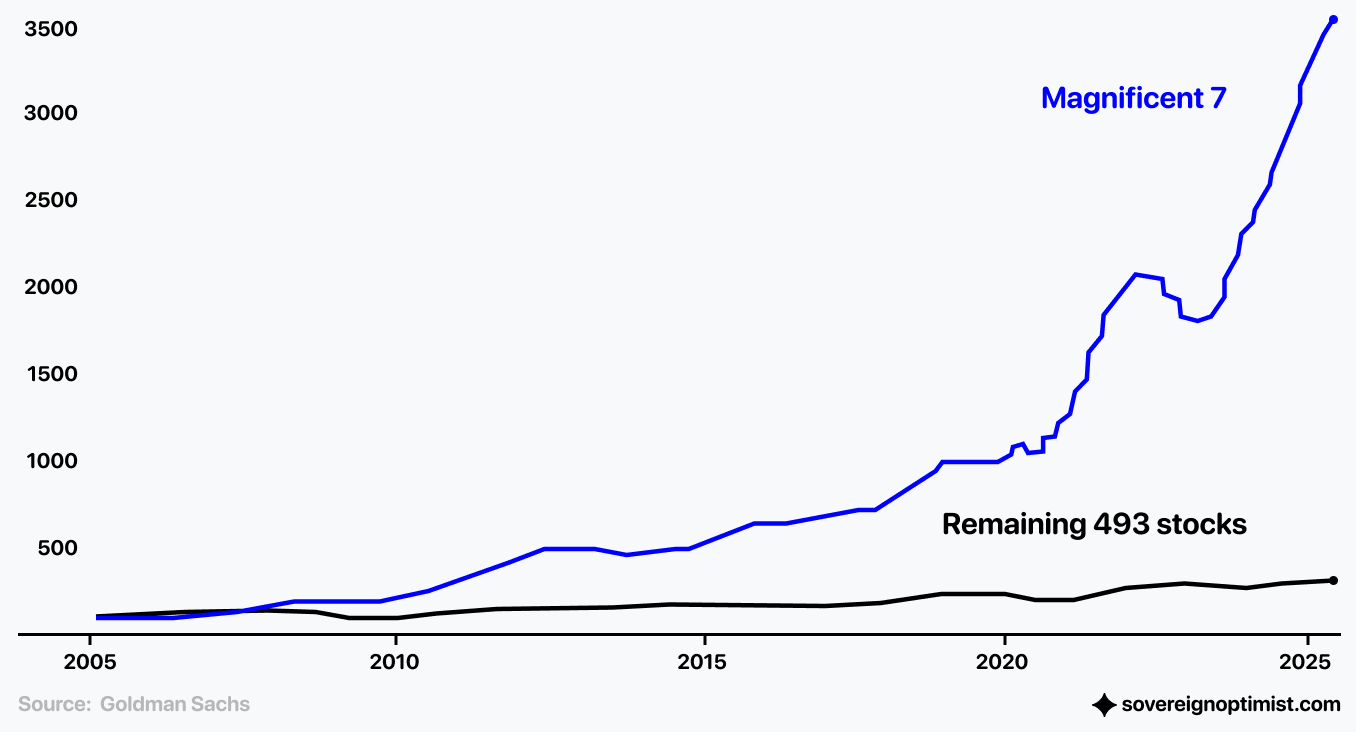
The top 7 companies in the S&P 500 index are responsible for almost all of the index growth, while the remaining 493 tickers are barely keeping up with inflation.
There are two independent reasons why:
Raising popularity of index investing escalates concentration in a mechanical way.
The “Mag 7” provides infrastructure without which you can’t run any business.
I wrote pieces about both topics (1, 2), but here is a summary:
Why Indexing Fails
The idea of index investing was revolutionary when the market was driven by the global collective of capital allocators and index was merely following the wisdom of the crowds.
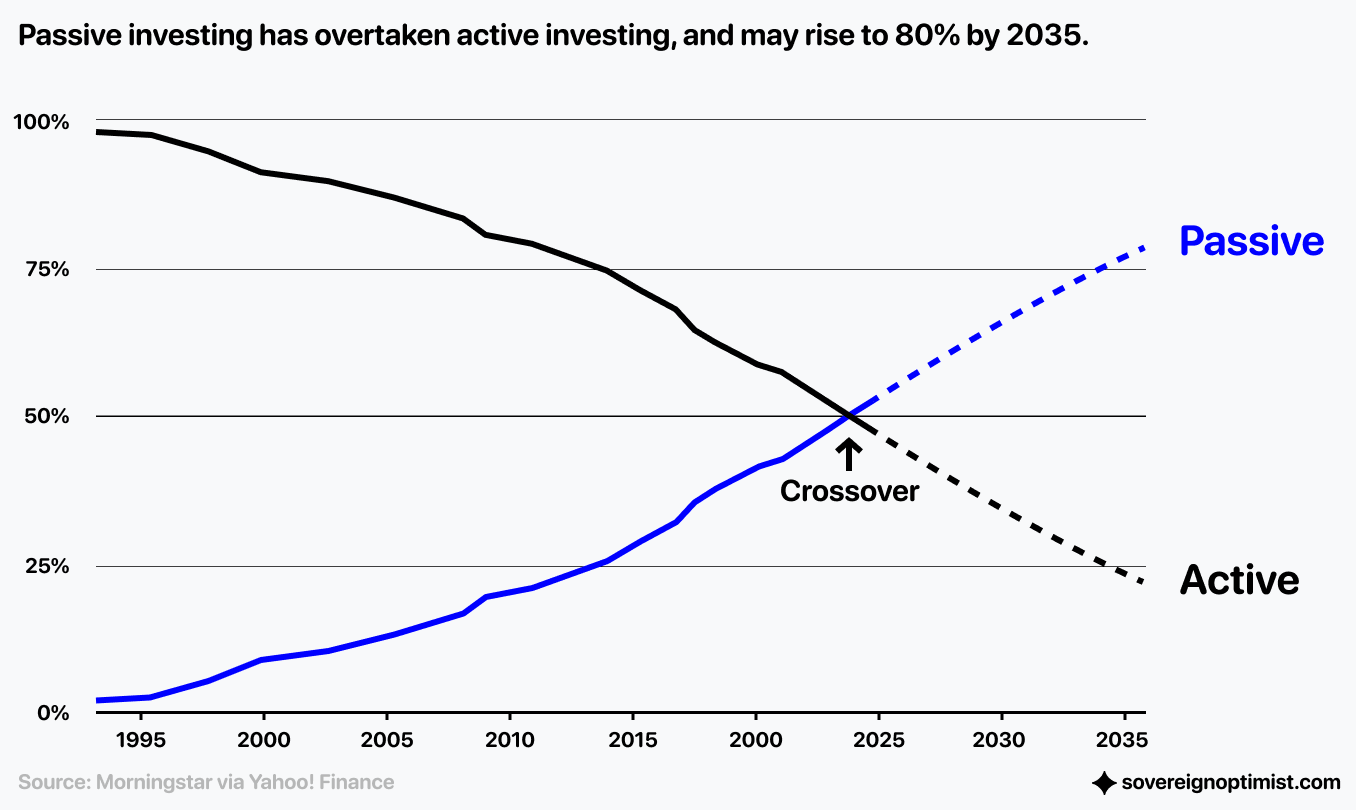
However, it doesn’t work when most of the capital starts to be allocated that way. You don’t follow any wisdom anymore. You follow previous investors, that follow previous investors, that follow previous investors… you see what I mean? Where are the allocators? Who picks the stocks? The crowd is still there, but the wisdom part is gone.
Today big companies grow just because they’re big, not because someone read the earning reports and thought “yeah, this looks like a good investment.”
But that’s not the whole story.
New Market. New Rules.
The new economy relies on the infrastructure provided by tech giants. It doesn’t matter if you run a bakery, a SaaS or even a logistics company, you need email, and 90% of emails are being opened in either Apple or Google mailbox. You need ChatGPT, Facebook ads, and orders from Amazon.
In this new market, a scenario where a bakery is doing better than Apple doesn’t make any sense. Any business that has profits must share them with the providers of the infrastructure.
The Threat
The threat is real. In a market where over 50% of capital is allocated passively, trillions of dollars are tied to stocks that barely trade besides being bought by ETFs. Everything works as long as pension funds are buying, but if the market will crash again, and ETFs will start selling blindly the same way they blindly buy today there is an ugly elephant-in-the-room question to answer:
Who is the buyer for Jack Henry & Associates and 492 other passively pumped companies in the long tail of the S&P 500 index?
If Not Index, Then What?
I already wrote about all of that. I’m repeating myself. But this time, I’ll give you a new answer. The one I found for myself.
I think it’s clear by now that I don’t believe in broad market diversification anymore. You want to diversify, but on the winning side of this new reality, and the winners are the infrastructure providers. Not even the top 100 tech companies, but likely no more than the top 20. In fact, the top 20 of the Nasdaq-100 represent 80% of its allocation—a perfect example of the Pareto principle in action.
Investing in the Mag 7 is nothing new. There’s even a MAGS 0.00%↑ ETF, but while it’s focused, it misses an important part: the automatic allocation that indexing provides. The Mag 7 stocks are picked manually based on the current winners. If you remember, before “Mag 7” there was FAANG, but (N)etflix has been replaced by (N)vidia, and we can’t know how the top will look in 10 years. Even today, the top 7 Nasdaq stocks include Broadcom, which is bigger than Tesla despite being much less popular as a brand.
Indexing is still the answer, and with fractional shares and automation, for the first time it’s accessible to small buyers.
Nasdaq 20
If you prefer to pick stock manually, I salute you. It’s not for everyone, but it’s a noble way to invest. I look for something that I can recommend to my friends, something that still works passively, and I came to the conclusion that the top 20 Nasdaq stocks are the most obvious answer.
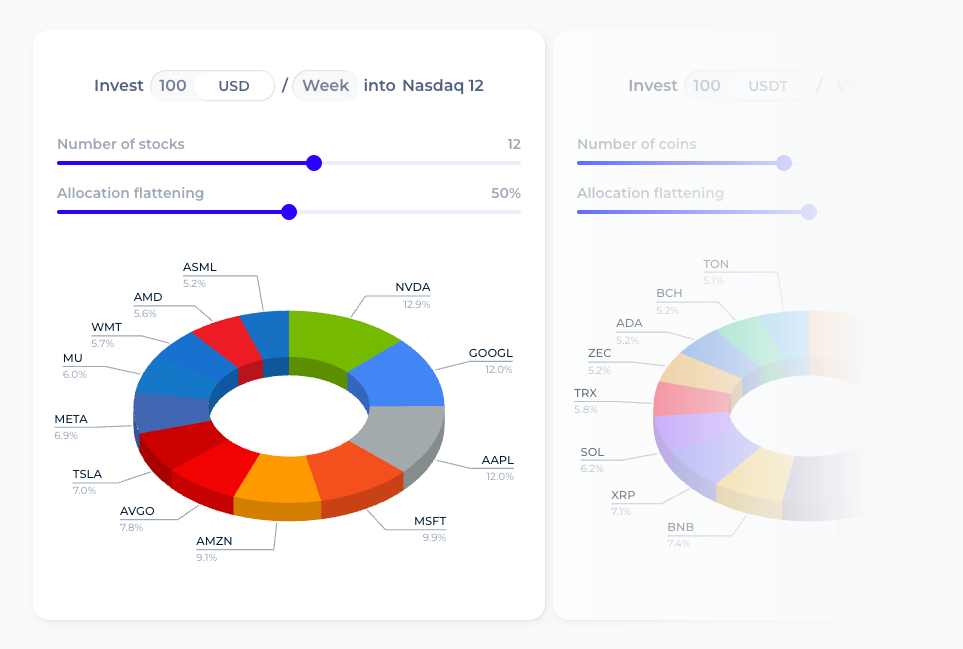
That’s why with the new index portfolio bot at Deltabadger, you can pick up to 20 top Nasdaq stocks and find a sweet spot between market cap based and equal allocation. Which configuration works the best? I have no idea.
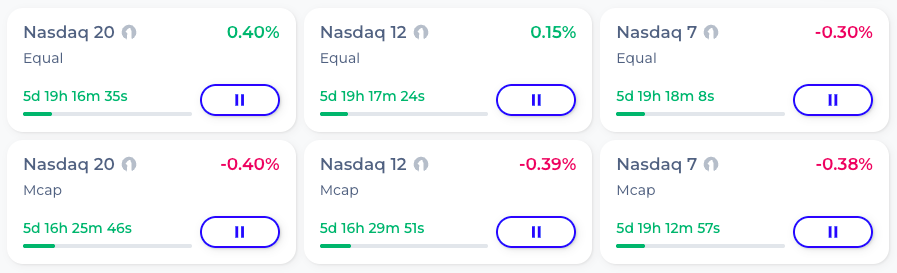
That’s why on Monday I started 6 of them: 7, 12 and 20 assets, each in both mcap and equal allocation versions. I will share results weekly in the Deltabadger Discord.
It’s a new world, and I don’t have all the answers, but this is where I am right now. These are the stocks in my Window Portfolio for the year(s) to come.